
Let’s talk about that perfect professional development day or that perfect staff meeting….It’s not that easy right?! Does it even exist? So often as administrators we are trying to make the most of our time with teachers but somehow all they want is time. Time can be such a powerful thing but we often are a little nervous about not filling the time we have with teachers in professional development or meetings. Or at least I am…I am a planner. In fact, I am an overplanner. I don’t want to come across as unorganized or not using the time wisely. I am desperately scared of wasting their time. I also struggle between the balance of setting action steps into motion with just the right amount of information, and filling the time with teachers with as much stuff as I can cram in. I somehow forget that less is more…I thought I would dig a little deeper into that notion of time and how we can give it back to teachers so that it is productive, efficient, meaningful and just what we all need.
I deeply believe that when you are intentional about crafting your time together as a whole staff, it makes everyone feel heard, understood, and perhaps may just set them into more action than if you crammed a bunch of stuff to learn into the hour together. The trick is you are also required to transfer information from the division office or just school activities and events that are happening. Not to mention, you are trying to build a growth minded culture that has strong collective efficacy. This is tricky stuff, which is exactly why I wanted to unpack this notion of teachers needing more time and how we can give them some of that time back without it being a waste. Teachers want time. We hear this over and over again, but yet if you are anything like me, I worry about how they use the time. Yet, I want to carve space for more flexibility within the professional learning time that we have together. I often wonder how can I create a structured space in order to give the time back to the teachers as much as possible with as much momentum and action taking as possible. I deeply believe that if we do start to look at how we can use the time so that it reaches the needs of a lot of teachers (let’s be honest, we may never reach everyone’s needs…), it cultivates fond feelings and trust. And when you nurture them along their way, they feel like you’re present with them, that they matter and that we aren’t just cramming unimportant and too much information into our professional learning space. So the big question is how do we give teachers back the professional learning time so that is powerful and impactful to them, and to the school as a whole. How do we give time back without it being wasted by all of us?
So for me, I dabbled in the power of giving teachers back their time. I experimented with not taking the time over but rather leaving it a little more open. It was scary…

This week, we had an ed council meeting with our teacher leaders. After last year’s feedback, the message was loud and clear. They wanted more professional learning time for themselves and more time for them to talk. So this week, we gave them more time. Instead of guiding questions during the warmup, we broke them into groups to just connect and talk about what they needed to talk about. Within our mini-lesson, we talked about how they were feeling and set a plan to get out of that feeling one small step at a time. Then, we gave them more time. Time to talk and work through some action steps. But here is the thing, sometimes when we give more free time, the time isn’t used as much as it should be or the way we think it should be used. I used to find this very frustrating. But then, I thought back to when I was a teacher too at one time. In fact, I still am. I went back to that feeling of teaching all day and what I needed. I needed time too.
But here’s the thing. We can’t just use time to just talk about our feelings, complain about all the stuff that is going wrong, and putting all of our kids and teachers in a box. For example, when we say that kids aren’t where they used to be or that they don’t know how to socialize with each other anymore because of the pandemic, it doesn’t mean all kids or adults. In fact, some kids and adults are flourishing, some are not. Some teachers are really having success with their kids implementing structure and some are having success with some and not so much with others. In this ed council meeting, lots of teachers were feeling overwhelmed and disconnected with their kids. This was very evident. But….some were not feeling this way. In fact, I am the same way…last week, I felt overwhelmed. This week, I felt like I had more traction and my feet under me a little more. We have to be very careful as leaders with how we use professional learning time to connect and carve space for teachers. We have to make sure that the time isn’t just a session all about how hard it is and all of the things that are going wrong. Yet, we need to create space for that too. However, if teachers are noticing some downward patterns or trends or gaps, then the best thing they can do, is not to use that as an excuse, but to use it as a place to start and take a step forward. Academic expectations should not change with how we feel most kids are coming to school but perhaps the way we deliver or approach the structure does. Perhaps the pace might change too. However, we must keep academics moving and continue to try to build momentum no matter where the students are at. We can’t let the obstacles take away the learning that must continue to happen. If we do choose to use our entire time to just vent then the gap will only grow. So, what do we do with time?

Let’s break this down even more:
- Co-construct criteria as a whole staff on what is important when learning and working during our professional learning time.
- Still get together as a whole for a short mini lesson on direction of action steps, reflection on progress, or learning something new. However, set a timer for 10-15 minutes and do not go over. Then let them go to do what they need to do.
- Leaders need structures for everything in order to build momentum and make progress for whole staff as well as teaching teacher leaders how to get things done when they are working on their own or in small groups. Set up and teach the teachers how to structure their meetings. Sandra Herbst and Anne Davies, who are giants in the field of leadership and assessment for learning suggest that you should set up a structure for: – coming together as a whole staff. – a structure for those in between times – what is it the teachers were going to be hyper focused on and have them set implementation plans and action. – a structure for sharing and reporting out
- Remember, there are times where you still need to all get together, just be more intentional with that time and how you fill it. If it can be read in an email, give them 5 minutes in that time to read the email but then move on. Don’t read housekeeping stuff out loud that they can read on their own. If you want to ensure they read it, give them time to read it, set 5 minutes for questions and move on.
- Set time for coming together to reflect on the work that the teachers have been working on independently. There is an importance of pausing every three weeks to analyze evidence and the best ways to analyze evidence to determine if action is actually working. This helps to give the leader a platform for support, know where the teachers are at and what they have been working on, give teachers time to share and celebrate the work, and set up next action steps. During these reflection and connection times as a whole group there are some questions that should be addressed. The questions are 1) What is your learning goal? 2) What will be proof that you will be working on it? 3) And how do you think it is going? Our school also sets up a google dashboard of documents or notes that teachers and admin can upload of the work they are doing.
- Teach teachers how to set one action step for the group to implement before leaving their meeting together. Set a plan to come back to reflect on the action step at the next meeting.
For our school, we have really worked on giving the time back to teachers with the intention of setting up a very specific structure to help them solve a top priority which requires their A+ effort. The teachers also have time to get done the B+ priorities that can pile up if they don’t address them. Our meetings are now geared towards a short mini lesson and then they have time to work on their own or in groups with very specific structures set up to act as roadmaps to help guide them to more productivity and efficiency. If you are interested in this exact process, I have a digital course called School Administrator’s Academy where I walk you through exactly how we do this as a school. The doors open for enrolment in January! We set aside reflection time every three weeks and we build in time to vent and connect. This has really changed the way we lead and the way we connect with each other. This is all because we intentionally set aside time for teachers to do what they need to do, showed them how to work with each other productively, trusted them enough to do what needs to be done and build momentum, and set an expectation that if there was a negative or downward pattern and trend that they were noticing, that we would give time to vent and acknowledge it but then set one action to start to move forward from it. This has changed the way we lead, the way teachers interact with each other, the way they work, the way we think about problems and hard stuff that comes up, and has built and grown our relationships. It has been hard every step of the way and sometimes we misstep but we always learn from it now, rather than ignore it and keep stuffing more things into our time together.
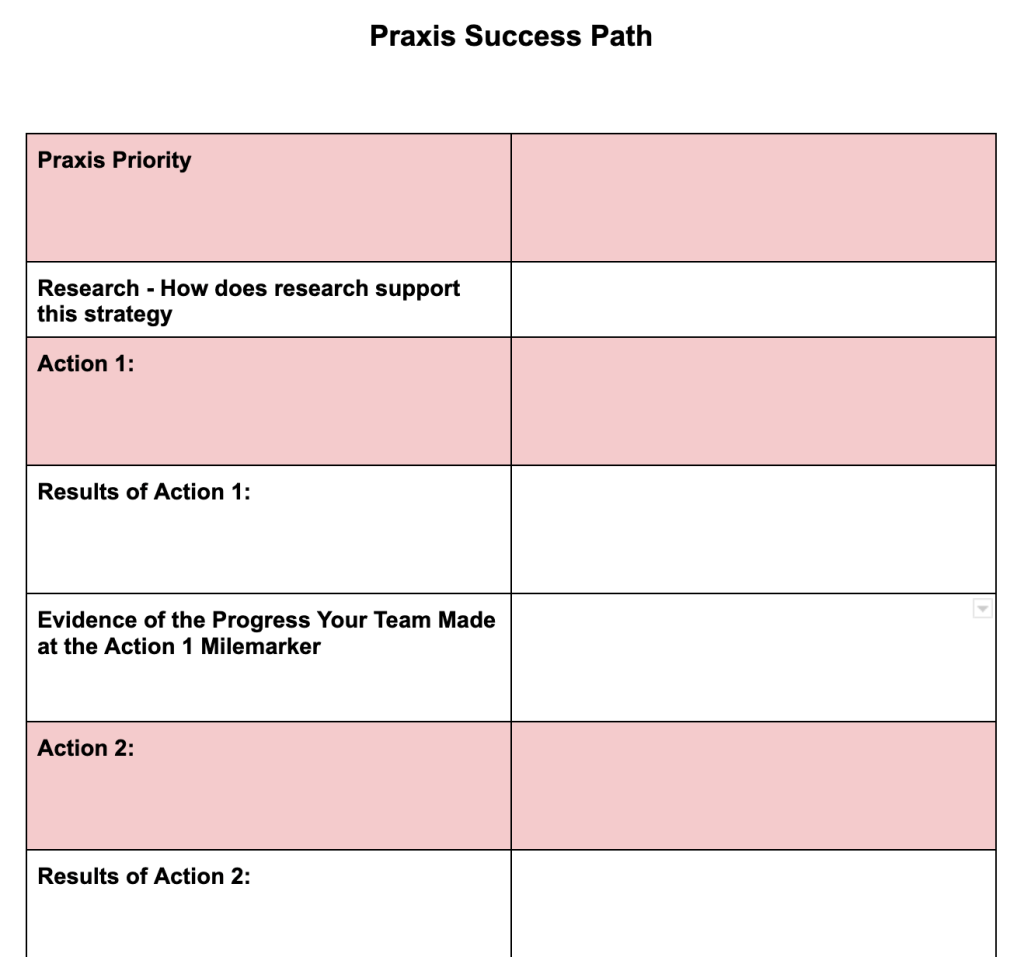
To recap, we talked about the importance of hearing teachers when they say they need time and then giving it to them. I also walked you through some steps to help you and teachers structure time so that is more efficient, productive, and gives them time to connect, vent, and build momentum and relationships. I also talked about how we use it in our school and how it has built a culture of trust and solution seeking thinkers.
Here are the next action steps you can take. As leaders, start to build a structure to give time back to the teachers with checkpoints along the way. I have a free guide that can get you started on how you might workshop your meetings so that teachers have more time to work together, you can download it here!
The power of time is the best gift you can give teachers to help to support them, if we are intentional about learning and teaching them how to use it so that it relieves the overwhelm…. not piles it on. Time can be the healer if we spend our time effectively. By setting up structures and following these steps to give time back to teachers, creates incredible alignment and therefore collective efficacy because it matters to everyone.
 Even If You Miss.....