One of the most powerful tools that you will use to navigate getting from one place to another is a roadmap. It has a start and an end point and some steps in between, with the intention to get you into momentum with clarity and direction. So….to me….we use this so effectively in our directional lives to get to places we desire but yet, we tend to forget about the power of a good roadmap in making things happen in our leadership. OR at least I did…anyone else?
I knew the thing I wanted most in my leadership was clarity to get things done, make things happen, and inspire and influence people in the best way possible in the most productive and efficient ways. Yet, I tended to just dive in without a plan and hope for the best. I expected people to know what I was talking about through my ramblings. I went too fast, I stuffed too much information into my storytelling and presentations, and I struggled with clarity. It wasn’t until I came across Sandra Herbst and Ann Davies, that I learned about the power of Co-Constructing Success Criteria. In fact, it immediately changed the way I lead, the way I implemented, and the way teachers took action. This is one action that you can take back to your leadership, and teachers can also take back to their classrooms immediately in order to get traction and get results right away. It is that good!
Now, I have also learned in my leadership journey, not to assume people know what the heck you are talking about. So let me break down what Co-Constructing Criteria is (yes I capitalized it because to me, it should be a household name!). I really want you to get the clearest picture about the impact it will have on your life and your leadership. Co-Constructing Criteria is building a set of expectations to gain success for a specific task with your community. The purpose is for it to serve as a roadmap of expectations in order to implement an action effectively because the success criteria expectations are so clear. I like to take it a step further and say that it also sets an expectation for people to prove their evidence of learning or implementation by justifying their work using criteria language. Google’s version of Co-Constructing Success Criteria is a student/colleague centered process that encourages students/colleagues to construct their own understandings of what counts in quality for a certain task. When people know what counts, they are able to set goals, self assess and improve their work.
Co-constructing criteria works exactly like a roadmap. The co-constructing of it (or the building/setting expectations) acts as the start line and the creation of the roadmap. The steps or expectations of criteria that you co-construct act as the steps in between that you must take to get from start to finish. The proof of implementing the criteria within the finished product or action is the finish line. The person then uses the criteria language to show proof and evidence of how they used the criteria right inside of their work or action. Magical and suuuuper effective! Here’s how you can implement it as a teacher or a leader:
Step 1: Determine the question you are looking to build criteria on. It is so important to pose one question that you are co-constructing criteria to answer. This provides clarity and a clear pathway for what you are setting up expectations for. It usually starts with, “What counts/matters/is important when…” I got this strategy from Ann Davies and Sandra Herbst.
- Leadership Examples: Some questions you might pose are: What is Important When Analyzing Results? This is the one that I will use in the blog today for an example. Some other examples are: What matters when contributing to professional learning conversations? What counts when writing report card comments? What is important when including students in assessing for learning? The sky is the limit for the questions you could set criteria for!
- Teacher Examples: What is important when writing a setting? This one is the example I will use in the blog post for the teacher examples. Some other questions are: What matters when writing a story? What matters when solving a math problem? What is important when decoding words? What is important when reading with expression?
Step 2: Model a specific action. Instead of just telling your community the expectations, model them while they observe. This gives them a visual of exactly what you are looking for. Some teachers/leaders even model an example or a non-example.
- Leader Example: A leader might model a leadership task or how to write a report card comment, or a specific teaching strategy. So for me, one thing I modelled to the teacher leaders in my community was how to analyze PAT results and set up an action step to address a gap in math. I took a piece of results and I modelled an example and a non example of how I expected them to analyze results. The teachers watched as I talked and wondered out loud for both examples highlighting what I really wanted them to notice.
- Teacher Example: A teacher modelled writing a setting in front of her kids thinking and talking her process of thinking and analyzing out loud as she wrote while the students observed.

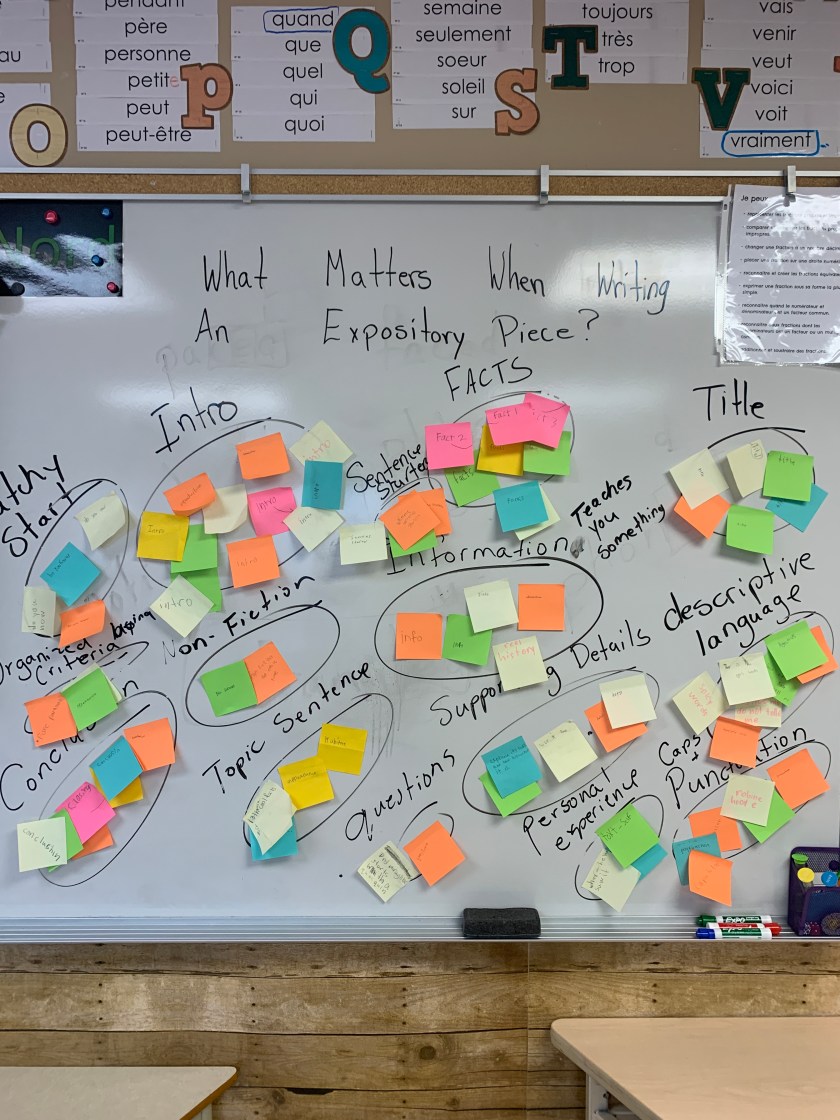
Step 3: Have the audience write one idea per sticky note about what they notice you do as you model. While you are modelling, your audience is expected to write about what they noticed you do as you worked through the action. They write one idea per sticky note.
- Leadership Example: As I modelled my example and non example of how I wanted them to analyze results with the intention to determine one action to address a gap, I talked and wondered out loud. I had already done a pre-list of what I wanted them to notice so I was super prepared to make sure that I mentioned and modelled these things. That is definitely a must! Always have a pre-meditated list of what you want to see on your list of criteria expectations. Each teacher wrote one idea per sticky note that they saw me do as a leader effectively to determine the results, gaps, and set up an action. They wrote things like, compare to provincial results, determine top three priorities and narrow down to top priority, set three actions and choose the one that is mostly like to gain the most traction, set teaching action, etc.
- Teacher Example: The teacher modelled her writing of a setting while she thought out loud. The students were asked to observe her and write one idea about what she wrote to answer the question, “what matters when writing a setting?” While she wrote, the student observed and wrote what they noticed her do as a writer. They wrote one idea per sticky note. They wrote things like, she used different sentence starters, she did a funnel effect, she used descriptive words, she used capitals and periods, she wrote four sentences, she used her five senses, she referred to a picture prompt, etc.
Step 4: Have the audience group and sort into similar groups and label the groups. In small groups, your audience will get together and organize, discuss, reflect, and connect their ideas into similar piles and come up with a heading for each pile.

Step 5: As a whole group discuss the criteria while the facilitator makes the master list. The leader of the group will bring everyone back together as a whole group and go in turns having each group share their criteria one at a time while the leader writes the master list. As groups mention a criteria, the people from other groups can come up and stick the criteria under the heading if it is similar. This way everyone is involved by sticking similar idea under the headings and a bonus is they are up and moving around.
Step 6: Leader takes the criteria back and creates a master list. I always recommend giving a copy of it to each person so they always have it as a roadmap to refer to. I always recommend referring to your criteria roadmap over and over again to sustain it’s importance and relevance to tackling that top priority.
Step 7: Set the expectation that your community will implement that action with the expectation to use the criteria and be able to show proof and evidence of using the criteria. This one is huge! Send your community off to implement the criteria and let them know that once they are completed (or perhaps during the process…), they will be expected to provide proof and evidence of how they used the criteria. The criteria also gives them the language of how you are expecting them to justify their work so it is definitely a win win!
- Leadership example: After the meeting, teachers were expected to analyze results in their grade teams for that week. They were to make notes and come up with one action to address a particular gap in learning loss in math. They had that month to implement the action in their classrooms and then bring back some evidence of the progress that happened because of the action they chose. The following month, we had a staff meeting and they coached each other on the process, the effects of their action, and then they were required to justify it with proof and evidence of work samples.
- Teacher Example: The teacher had the students write their setting implementing the criteria they had co-constructed. After, they had to circle, label, and highlight exactly where they showed proof and evidence of using the criteria. The last step was they coached each other showcasing where they used criteria by using the criteria language and the sentence starter, “I want you to notice….” Powerful stuff!!

Step 8: Have your community coach each other on the results and proving where they used the criteria. I kind of already talked about this one but I wanted to say it again because it is that important. By having the community co-construct expectations, implement them, provide proof and evidence in the action of implementing the criteria, and then justifying and coaching each other, you have a very clear roadmap of the quality you are expecting.

So there you have it! A step by step roadmap of how to build a roadmap! I know, funny…But in all seriousness, this is the biggest action that I have implemented that has made the biggest difference in my clarity in leadership, expectations for teachers, and results for students. If you want to learn even more about how I set up a system that solves problems and gets results in schools, the doors to my digital course called School Administrator’s Academy opens on Feb. 22, 2022! I will help you to set up a system to solve problems, grow teacher leaders, grow your leadership, and get results in student learning and teacher engagement and motivation. By the end of this 13 week course, you will go from overwhelmed and frustrated with a disengaged community to having clarity on how to solve problems and get teachers solving problems, leading an engaged/motivated teacher community, and improve student learning through a very specific automated system. Sounds great right? Stay tuned…I will also be running some free masterclasses within that week so be sure to sign up once I have sent the link.
I also have a free guide to Workshopping Your Meetings that includes how to co-construct criteria. You can download it here! Have you joined our private facebook community called Principals and Leadership? Lastly, for more tips and tricks, follow me on social at evenifyoumiss1 on Instagram and Jacealyn Hempel on Facebook. I can’t wait to learn and lead alongside you!
 Even If You Miss.....