
Building an army of leaders is always a big dream and a huge topic for someone who runs a company, family, or school. Imagine having a group of people who want to be leaders, want to do the best work of their life, want to find solutions to problems, and extend their reach as much as they can to influence and inspire others! It’s a huge dream and one I have been passionate about for a really long time. My favorite part about leadership is not the administrative duties that run a business or a school but rather the power of influence and ability to inspire others to find passion and purpose. I want to build a community of passionate people who are in the muck alongside each other trying to figure it all out. It is a community who falls sometimes because they took risks, but knows to sit in that feeling for only a little while, and then to do the work to get back up. It is a community who knows how to snatch the momentum and power back with passion, presence, and purpose. It is a community of more than one leader but rather an army of them.
The thing about all this dreaming, is that it is extremely hard work trying to make it actually happen. This year our leadership team felt like we needed a revamp. Reflecting back on the past years of our Ed Council, which was our leadership meeting, we felt that we were losing the presence and purpose of it. Our teams were getting smaller in numbers and we felt we weren’t serving our leaders in the best way or even showing them how to share their expertise and mastery in the most impactful way. We wanted the leaders to influence more than just their small teams. We wanted to build not just grade team and classroom leaders, but school wide leaders. We went to work and started to revamp and rebuild how we develop leaders in our school. The whole purpose of doing this was to build people who had more influence and reach, to engage more voices from the members of their teams, and to improve student learning and teacher craft overall. We began to search for ways to support the leaders in our school by unveiling and revealing ways of being with their colleagues that actually allow relationships to flourish and professional learning to burgeon and grow.
Now before I give you a glimpse of how we are revamping, I want you to know that this is a work in progress and it is mucky and nowhere near figured out yet. But sometimes that is where the best work and clarity happens…through the questioning, discussion and work. So here it goes….
I started by really taking a deep dive into our leadership program now. I asked myself the following questions, which came from a course I was doing with Sandra Herbst and Anne Davies:
- What does it mean to facilitate and activate people’s agencies?
- What does it mean to be a teacher and a leader of adults?
- What are the best ways to activate the power of those around us?
- How am I lifting into my own leadership practice through actions in the service of learning?
- What are our pain points?
- How do I engage more voices, provide clarity, and gain more momentum?
I brainstormed and really dug into the meat of these questions and our admin team reflected as a whole as well. We knew if wanted things to build momentum then we had to make some changes. We realized that we needed to perhaps switch from having grade team leaders to having subject or areas of need leaders. So for us, some examples of this might be:
- Assessment for learning leads
- Reader/writer workshop leads
- Math workshop leads
- Learning Support Leads
- Team Teacher Leads
- Coding Lead
- New Curriculum Lead
After that we hashed out how this might look. We talked about how we would organize time inside of our school day to allow cohorts of teachers to meet. We also explored how we could still create and keep time for weekly grade team meetings. Next, we talked about how we might organize the number of team leads per cohort, how often they would meet, and what these meetings might entail. In our school, we decided that we needed to keep the weekly grade team meetings and so we will continue to keep each grade team’s common prep attached to a lunch time. We decided that we will have these cohort professional learning times to happen during some Friday professional learning community times. Some other decisions we made, were whether or not the cohort would stay on the same topic all year or perhaps do a big rock and a little rock.
Once we mapped out our decisions on the topics of teams, who we might want as the team leads, and how, we spent time on how we would deliver our idea to our current team leaders, we explored how we would cast the vision. It is important to really thing about the clarity of your vision and have it hashed out already before you deliver it to your community. In fact…it is a lot like marketing! Here are some steps we took when considering how we would prepare our team with the vision we were creating:
- Be sure to map out the details of your vision before hand. Know the what, the how, and the why. This is not to stand and deliver them the vision, but to create a sense of clarity before digging into the work with your community. You need to prepare for what may come and knowing the big rocks before hand is super important
- Think about how you can be straight to the point rather than long winded and confusing. This helps to build clarity. I often box out my idea in point form and practice it before I deliver my ideas. I also write out a 30 second elevator pitch and practice it with someone to ensure they understand my messaging. My brother is such a trooper for always being my audience of one!
- Include the community in the decision making by preparing questions and topics of discussion. Even though you have already hashed out most details, including their ideas is essential. This is for many reasons. They may come up with things you haven’t thought of and it also gives them ownership and responsibility of the vision. Paint the vision and then co-construct the details with the group of leaders.
- Plan how you will engage ALL voices and gather data from the visioning conversation. It is not enough just to have a huge conversation and you take all the notes. The same people are always the ones doing the talking. Think of ways to get more people’s ideas in efficiently and effectively. We use shared google docs, chart paper and groups, walk and talks, process observers, gallery walks, carousel discussions, etc.
- Reflect on the data from the conversation and decide on the first step of implementation of the vision.

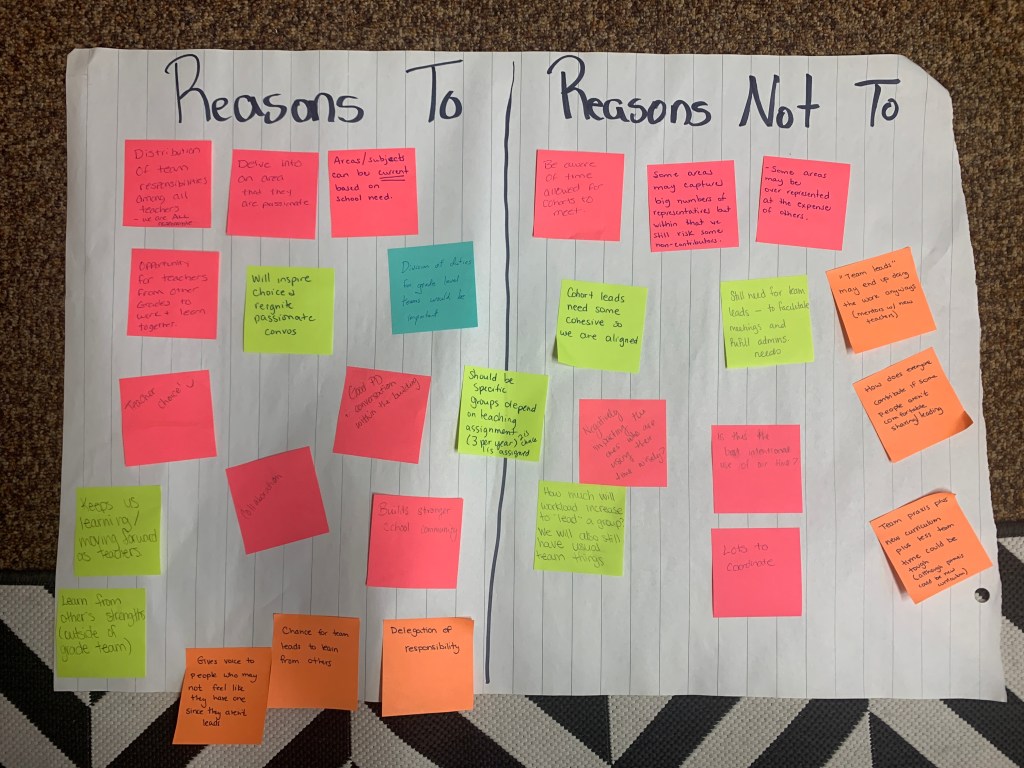
Our admin team planned all of these things before bringing the vision to our leaders. During our meeting, we cast the vision and then got the leaders doing more of the ‘how’ work. We had them in small groups and we asked them to write on sticky notes (one idea per sticky note) reasons to change the leadership format and reasons not to. They then posted it on a T chart. This was a really quick way to validate reasons to and reasons not to. We had a quick conversation about pros and cons and then made the promise to look back on their ideas and get back to them.
Next, admin reminded them of the vision and went on to talk about how we might implement this opportunity for growth (rather than saying change) in leadership. We quickly moved them into small group discussions again with a google doc that guided their conversation for things to think about when creating a roadmap of how our leadership teams might look next year. Teams dove into this! They had clarity on what was expected of them through the quick mini lesson and google doc, and their ideas could be validated through conversation and inputting it right into that same google doc. We would then have some pretty amazing data to reflect on and make decisions on next steps. After, we had a quick, to the point, whole group conversation with the promise of considering their ideas and presenting them with the next step at the following meeting. The work of this meeting was massive and the conversation was very directed, focus, present, and purposeful. It was all in the preparation of visioning before the meeting, the dedication to co-construct ideas alongside every voice in the room, and the intention to reflect on the data and come back with a concrete, streamlined, and clear plan to move forward. Validating their concerns and work they have already done is also so essential. We needed them to understand that it wasn’t because we didn’t like the work they were already doing (in fact, it was incredible work) but rather, it was about extending their influence beyond their teams of two. It is important to present a new vision as an opportunity for growth and a chance to take a risk rather than a change that throws away all of the work they had previously done.
There you have it! A quick glance into how we presented an opportunity for growth and a vision to our leaders. Overall, this process is still messy but it has been the most intentional, engaged, and clear conversations we have had with our leaders in years. Some next steps that came from our meeting were, to perhaps consider creating a common meeting template to follow for these cohorts to help them be productive, efficient, and find more clarity. I have one that we had previously created that some of our leaders currently use that works really well to help team leaders to run a productive and efficient meeting and still have some time to connect. You can download it here!
Another next step for our admin team is to take the data we collected from this meeting, analyze it, and figure out who our leaders will be and how we will coach them to present it to the rest of the staff to start to form cohorts. We will also explore some ways that adults learn best to help our leaders facilitate a learning journey rather than just teach it and do all the work themselves. For example, we will look at best ways to research, develop roadmaps, co-construct criteria, set deadlines and dates, activities that include setting a task to implement in classrooms and then coming back to analyze how it went, analyzing work samples, co-constructing best teaching actions, etc. Like I said, it is all still messy but it is one of the best conversations we have had to date because of the actions I just talked about in this blog. I hope this helps with the many questions I have received on how we develop leaders in our school.
PS….Have you joined our private facebook group called Principals and Leadership yet? Also, I have a website, a digital course, and I am starting a brand new membership that teaches moms how to be more productive and efficient in their careers and personal lives. If you are interested in becoming a founding member to this brand new membership, email me at jacealynh@gmail.com to let me know and I will get you even more info!
 Even If You Miss.....