
According to John Hattie, visible learning is one of the most effective ways to build collective efficacy and improve student learning and teacher craft. Visible Learning means an enhanced role for teachers as they become evaluators of their own teaching. John Hattie states that visible Learning and teaching occurs when teachers see learning through the eyes of students and help them become their own teachers. In other words, it establishes that the learning must be obvious, rather than assumed.
Visible learning also fosters collective efficacy because it makes the learning visible so that teachers can learn from each other and align practice. This type of documentation of practice promotes conversation or deepens understanding about one or more aspects of a learning experience. It instantly gives the visitor inside of the classroom, as well as the students who are learning, a visual of the learning that is happening. It also gives them tools to refer to, a roadmap of the learning, and the language to justify and dive deeper. It sets expectations of the quality that is expected. The best part, is that visible learning also helps to boost student’s own confidence and expectations of themselves because they see language, work samples, and models to strive for.
According to John Hattie (author of visible learning into action), visible learning promotes deeper and transfer thinking. It helps students and teachers to articulate what they are learning and why, helps them talk about how they are learning and the strategies they are learning, and they can articulate their next step.
So many classrooms are lined with beautiful and expensive posters. The problem is, that most of the time, nobody uses the posters to learn. Now imagine the walls being covered with the learning as you go. This does not have to be posters but rather chart paper, pictures, educational language, co-constructed criteria, etc. that goes up and is created right inside of the lesson. The students are now co-constructing it, having ownership of it, and using it to boost learning, expectations, clarity, and feedback. Another bonus can occur when a visitor walks through the doors. The students have ownership of what is on the walls because they created it alongside the teacher. They can speak to it and the visitor knows what to ask because the learning is displayed on the walls.

To achieve this, teachers use learning intentions and success criteria on a daily basis. If you have been following me for awhile, then you know how much I love co-constructing success criteria. These are the perfect examples of powerful visible learning. Learning intentions and success criteria contribute significantly to teacher clarity, which Hattie’s research shows, can double or triple student learning. Another critical part of increasing student learning is to attend to the three phases of learning: surface, deep, and transfer.

As teachers and leaders we need to know how what we do impacts student and adult learning. We need to be aware of our own impact. It is necessary to model, inform and co-construct what success looks like right from the beginning. Through displaying the learning, it becomes a safe space to wonder, make mistakes, celebrate successes, collaborate, give feedback and so much more.
In order to make visible learning happen in schools (where the walls are covered with the learning and language that is happening), principals have to nurture and teach about effective ways to make visible learning happen.
Here are some ways that may help to promote visible learning:
- Start by teaching teachers through modelling about the importance of co-constructing success criteria alongside their students. Build criteria for a top priority right inside a meeting and take the teachers through the process as adult learners. An example of this might be: What is important when writing stories? – The teacher/leader would model writing a paragraph and thinking out loud (or they could also present a work sample and wonder out loud about it while the students watched). The students watch and write on idea per sticky note about what they notice you do as a writer to bump up your writing. They group and sort into similar groupings with headings. After, the leader gathers the whole group together and they share and co-construct a master list. This criteria is placed where it is visible at all times for students to follow to write their own stories. They will also use the criteria language to give feedback to their peers and self assess themselves by writing right inside the assignment where they had proof and evidence of following the criteria. Leaders need to teach teachers how to do this and so, again, I would suggest leaders co-constructing criteria right with the teachers so they can experience it and see it modelled. This year we co-constructed what is important when doing assessment for learning and built criteria along that. This criteria lives all year long and is used to notice progress, give feedback, and coach each other.

- Set up times in the year for teachers to coach each other on the visible learning that is happening inside of their classrooms. Have teachers take each other to their classrooms for some viewing of the learning that covers their walls. The visiting teacher should have a pretty clear idea of what type of learning has been happening because they can see it all over the walls. From there, they can ask questions, look at work samples, analyze the walls, and share strategies that are working for them to promote visible learning. By setting these coaching sessions, it also spurs the teacher into motion to actually implement some visible learning strategies. I use the walls of learning to evaluate and observe teachers who are on the observation rotation each year. I walk in, look at the walls, and then start talking to the students to see if they can internalize and justify what they have been learning. It ignites some pretty amazing conversations without the teacher even being a part of the conversation yet. This speaks to the hard work and impact that teacher has had on the learning of these students. They not only know how to do assignments, but they can talk about their learning, justify it, and show proof and evidence of progress using the criteria language and visible learning strategies.

- Another great idea that you could do is look at ways to get students and teachers working outside of their classroom walls to promote visible learning and teaching strategies. In our school, we installed whiteboards in the hallways and so our halls are constantly filled with learning, conversations about thinking, and collaboration. Students even leave the work on the whiteboard and other students will give feedback.
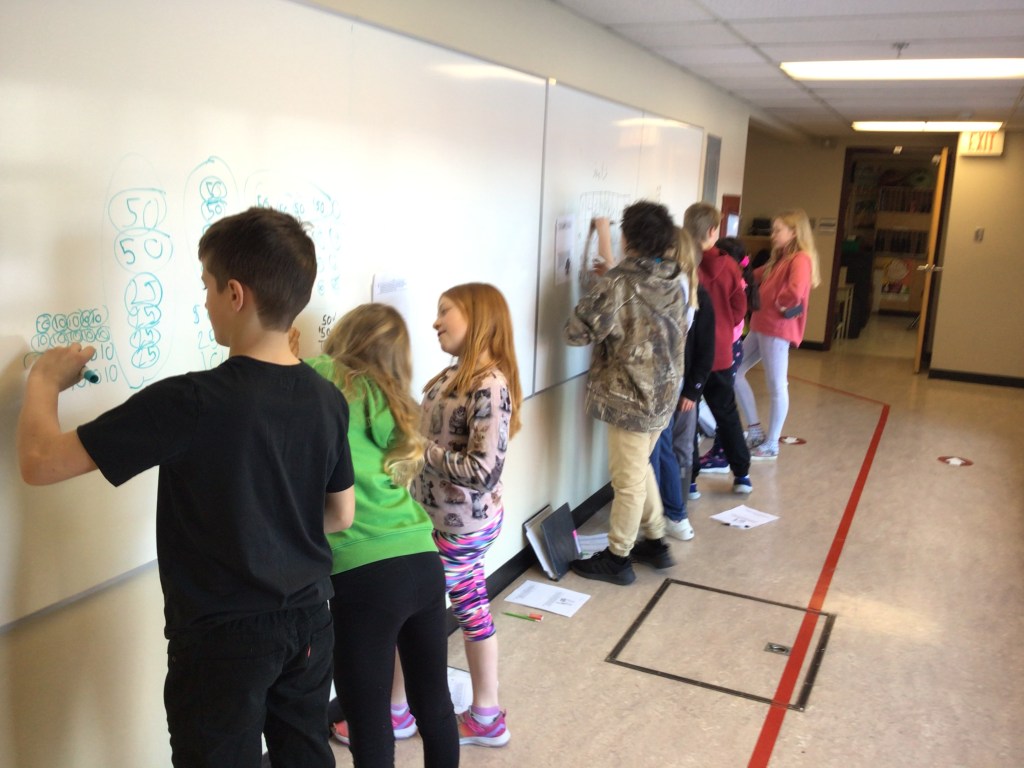
- Team teaching is another great way to make the learning obvious and visible. Teachers teaching together will learn from each other and students can also have learning conversations with peers from other classes or grades.
- Take an ipad around the school and take pictures of the visible learning on the walls and promote it on social media or within your professional learning meetings. Sometimes just snapping a picture can teach so much!

- Teach teachers how to build vocabulary walls as they teach and learn new concepts. A lot of our teachers start out with a blank math wall and as they learn new math strategies and vocabulary they add to the wall right inside of the lesson. Powerful stuff! Other teachers in our school write incredible words and phrases as they come across them in books they are reading as a class. Students can then grab and pop them into their own writing or have conversations and learn deeper about how authors hook their readers.

These are just a few ideas of how school administrators can teach teachers about how to make visible learning happen and actually make an impact. It validates the work teachers are doing and presents the impact they’re teaching had on the learner. It builds that collective efficacy and alignment and brings the learning outside of the classrooms so they’re reach extends further. Visible learning can also be the key to motivation, inspiration, and engagement for student AND adult learners!

Have you heard?! My digital course called School Administrator’s Academy is officially open for enrollment! This will be the last time this year that this course will be offered. In this course, you will learn how to inspire and motivate teachers, improve student learning, and find passion and purpose again through a step by step system that teaches you how to build collective efficacy, time manage, and tackle top priorities. Hurry though! The doors close for the year on June 22 at midnight MST.
I also have the last of three free masterclasses called 3 Secrets to Leading a Super School happening Wednesday, June 22. Click here to enroll now!
Hattie, J. (2012). Visible Learning for Teachers ([edition unavailable]). Taylor and Francis. Retrieved from https://www.perlego.com/book/570741/visible-learning-for-teachers-pdf (Original work published 2012)
 Even If You Miss.....