
Good teaching is good teaching. No matter what language or subject you are teaching in, good teaching that engages, inspires and motives the learner will prevail. The teaching and leading actions stay the same, the only thing that changes is the outcome or subject. The same goes for leaders in schools. They are teachers too and how they teach, matters. The difference is that their students are adults for the most part. In meetings, leaders teach and use these same actions that we ask our teachers to use with their students. In our school, we have identified 6 teaching actions that have really impacted our students and improved their learning overall. These actions were a result of our work with Anne Davies and Sandra Herbst. We started with studying their work for assessment for learning and I soon came to realize how much these actions impacted student learning. I began to wonder if these 6 specific teaching actions might also affect adult learners. I started to implement these actions into how I lead meetings and how I taught students. Teachers did the same and we instantly saw more engagement, more joy in teaching and leading, and student results were improving the more we implemented these teaching and leading actions.
Like I stated earlier, I use these actions to teach teachers how to engage students in learning, improve results, and gain more evidence for assessment because the students are included in gathering their own evidence of learning. Now, I also use them when I team teach with teachers, in professional learning meetings, and we use these specific actions to unpack a new curriculum. We have been doing these actions for about 8 years and with each year it becomes more and more engrained in how we do things around here.
Here are the 6 actions I use as a leader to engage adult learners. I also teach teachers how to use these exact same actions in their own classrooms:
1.Stating the Outcome Before the Lesson/Professional Learning Meeting: This means putting what you want the learner to know, do, and articulate by the end of the lesson in student friendly language to provide clarity, expectations, and a target to hit by the end of the lesson. So for me, I always put the outcome at the beginning of every meeting with teachers so they know the purpose of our meeting and what I am going to expect them to know, do, and articulate by the end of the lesson. If you are teaching a lesson, then you would put the outcome pulled from the curriculum in student friendly language on the board and talk about the fact that you want them to be able to prove that they know this outcome, can do it, and can articulate it by the end of the lesson. It sets up a clear roadmap destination for the learner so they know exactly what is expected of them and why they are doing what they are doing. It is a simple action but one that gives people complete clarity. In my world, clarity is the key to action and success.
2.Immersion Into a Work Sample, Modelling, or Task – The definition of immersion is the act of putting someone in or exposing them to the work or task that you are expecting them to learn. In other words, it means to dive into a model, a work sample, or a task and start to unpack it before you have learned anything about it. By immersing the learning, it allows them to have an experience and take responsibility to explore, unpack, and build criteria before they have learned anything about it. It is similar to beginning with the end in mind. This might look like the learner watching the teacher/leader model thinking out loud while they write or do a math problem, and then they notice the criteria that the model did. Perhaps a leader puts up a piece of student writing on the smartboard within a meeting and then teachers pull out the mini lessons that could come from that piece of writing. It might look teachers looking at student work samples and co-constructing criteria on success criteria. Students might look through math problems or manipulatives and notice different math strategies they might use with that particular problem or manipulatives. The sky is endless as far as exposing and immersing learners into models of work or watching a teacher/leader model. Having the learner be exposed to models before the learning happens can give them a visual of what the expectations are before they learn about it. Showing learners models of finished products, gives them a much clearer picture of what they are shooting for.
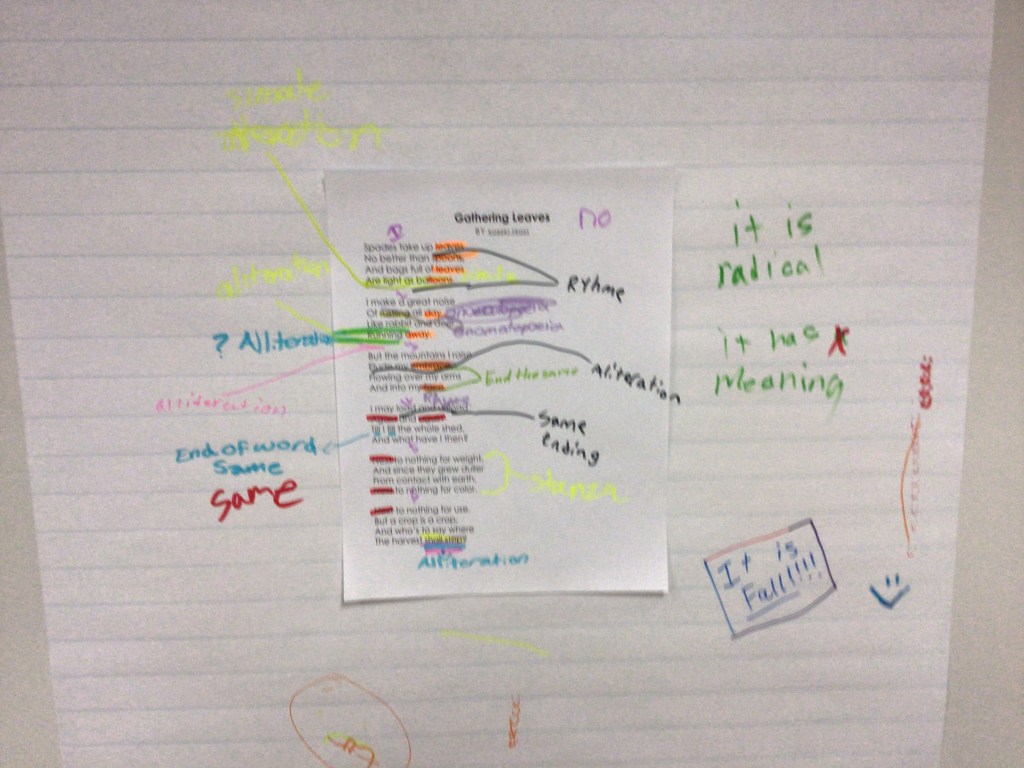
3. Co-Constructing Success Criteria – We do this for everything! We usually do it at the beginning of a unit or when we are looking into a top priority in our leadership. Co-constructing criteria is a learner centered process that encourages learners to construct their own understandings of what counts in quality work. When learners know what counts, they are able to set goals, self assess and improve their work. It is essentially backwards planning. It’s going over a model or an assignment and co-constructing through conversation and modelling how to be successful on it. I like to think of it as unpacking steps and criteria that should be included for the learner to be successful. In my leadership, this might look like modelling a workshop mini lesson and wondering out loud while teachers write down the criteria that they notice me do to build an engaging mini lesson. Teachers have written a part of a story in front of the student wondering out loud, while the students notice the criteria the teacher did to make the story interesting. We build criteria for many things, such as what is important when contributing to professional discussions and learning. What counts as high quality report card comments? What is important when conferencing with students? These are just a few examples. Through building criteria it gives the learner a roadmap of what to include to be successful and it gives them the language to assess their own work and give feedback to others. There is no one way to co-construct criteria but I like to do it using sticky notes and modelling.
How to Co-Construct Criteria:
- Develop a question using one of the sentence starters, What is important…., What counts…., What Matters….
- Model and think out loud in front of your learners or provide exemplars to immerse and expose the learners to quality work
- While modelling or immersing into work samples, have the learners write the criteria the notice the model do to produce high quality work (one idea per sticky note)
- In groups, have the learners group and sort their criteria into similar groups and write a heading
- As a whole group, have groups share their criteria and build a master list. If another group has that criteria they can also come up and put it under that heading. This includes all voices.
- Once completed, you will have a master list of the criteria on how to produce quality work, conversations, etc. and have the language to self or peer assess and give feedback.
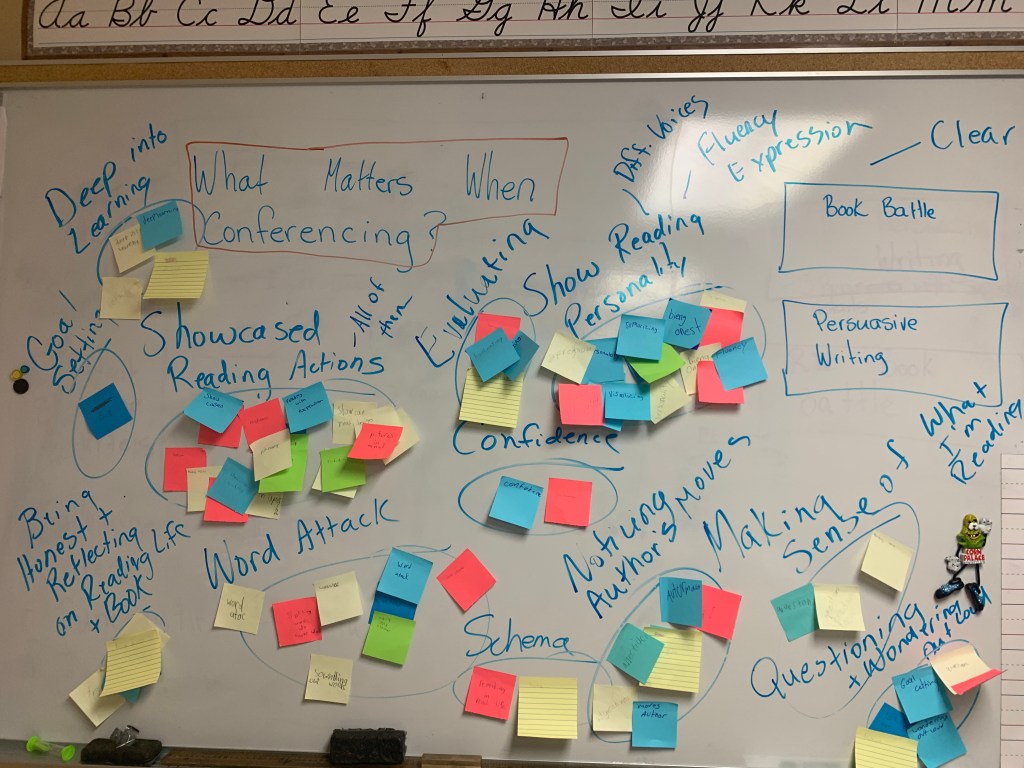
4. Short 10 Minute Mini Lessons that Engage As Many Voices and Contributors As Possible. We encourage that, in any lesson or meeting, the mini lesson is 10 minutes long and it engages as many voices as possible. I try to do this in meetings as well. We explore ways to include learners in your presentation or mini lesson. This might look like using whiteboards to answer questions or contribute their ideas, including turn and talks, getting learners to notice criteria that the teacher did on sticky notes, having a backchat forum on computers to post wonderings or questions, etc. By including as many contributors as possible requires the learner to do more of the thinking and learning rather than just sitting at the back and zoning out. The person who is doing the most talking is doing the most learning. I also suggest stating and posting your outcome that you expect the learner to know, do and articulate by the end of the lesson at the beginning of the mini lesson. This gives them clarity on what it is they are expected to learn and do.
5. Independent/Collaborative Group Time – After the mini lesson, have the learners work together in groups or individually to apply what they learned from the mini lesson. Get the learners doing more of the work and application immediately after learning it to ensure that the learning lives on. This might be getting learners to work through work samples, build lessons, research, develop criteria, analyze data, etc. This allows learners to experience what they just learned and put it into action with support. It gives them clarity as well.
6. Assessment That Requires The Learner to Present Proof and Evidence that He or She Learned the Task/Outcome – This action is crucial. At the end of every lesson or meeting, it is essential to put the responsibility back to the learner to show that he or she learned the action. Have the learner either talk about it, label it using criteria language inside the work sample, present a product that showcases they followed the criteria and have them speak or label it, exit slips etc. My favorite way to get learners showing proof and evidence is by having them develop a product and then either talk about the criteria and show how they implemented it right inside of the product or have them label the criteria and state how they implemented it. Teachers get students to hand in a piece of writing that has the student’s labels of criteria right inside of the writing to prove they followed the criteria. This is a powerful action that requires the learner to not just do something but to analyze it and prove that they went deeper by following the criteria they learned from the lesson. Proving the learner might also be through having the learners self/peer assess and give feedback using criteria language as well. This doesn’t have to be a giant action but it is a very necessary action because it puts the responsibility back on the learner to take action and prove that they did. It also promotes a deeper level of learning because it requires the learner to implement what they have learned.
So there you have it! These 6 actions are something that teachers in our school do over and over again in their classrooms and it is how our admin team leads meetings and professional learning communities as well. In fact, this year, Alberta is in the process of piloting and implementing a brand new curriculum so teachers are taking professional learning times to work together to unpack the curriculum and develop lessons and support documents using these 6 actions. It is powerful stuff! These actions not only instill deeper learning and better results but it makes teaching and leading fun again because it includes the learner rather than the leader doing it all. Learning these 6 actions will take time but it is worth it. Start with one action and practice it for a while before adding another action to the mix. Soon, these actions will become the very Touch Trees of your leadership and how teachers teach.
If you want a free guide on how we do some of these actions in our meetings, click here to download now!
Have you joined our private group called Principals and Leadership yet?
 Even If You Miss.....