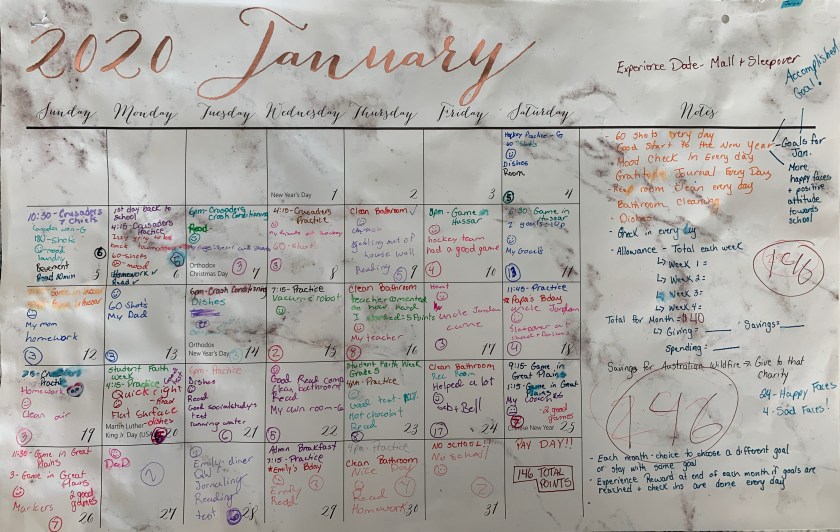
I know this title sounds a little sketchy right? How on earth can we get kids to take inventory of their time at such young ages? Well…I am here to tell you that this really simple idea actually works and it has been working for our family for almost five months. I am super excited and truly honest when I say that it has been a real help when it comes to organizing and teaching kids how to keep track of their days.
This tool that I am talking about does not cost a thing. Ok maybe a few bucks but all you need is a monthly calendar. That’s it! Oh yeah, and maybe some really cool pens just because. This calendar can be all that you need to keep track of our minds, our bodies, our schedule and our lives.
It has been such a game changer in our house that I really wanted to share this idea with you. After all, my goal is to improve the world through the the kids and the people who lead them, so this topic today is very relevant. It teaches kids at the youngest of ages how to notice where their time is spent. I thought I would share with you how this idea has evolved and how much of an eye opener it has been to my own kids.
Here is how it works: The first thing to think about is how you are pouring into your three buckets each day before deciding what to track in your calendars. The three buckets for kids are family/friends, learning/activities, and Mindset. The goal each day is to make sure that you pour into each of these buckets equally and when you do spend time with each bucket to make sure that you are fully focused and dedicated to that time and not distracted at all.
We started with going out and buying a larger monthly calendar last January. Next, we had a family meeting about what are some of the things that we would like to keep track of in our lives.
We then talked about the three buckets and made a plan to fill each of these equally each day. The first bucket we looked at was learning/activities. We decided to track our reading and homework. The next bucket we looked at was mindset and we decided to track our gratitude each day. We wrote right on the calendar what we were thankful for for that day. The third bucket was family/friends and so we tracked if we spent time with family or friends that day. (For example if we played a board game then we wrote board game). We kept looking at each bucket and then deciding what we would like to track from that bucket.
The next thing we did for the month of January was set a goal. Each kid chose their own goal and it was just one. They tracked each day if they were taking steps towards that goal. For example, one of my kids wanted to do the 3000 hockey shot challenge so she tracked each day whether or not she worked towards that goal. Her goal was to shoot 60 pucks a day. Another goal might be to make their bed every day. Or drink more water, or play less video games, exercise three times a week, work on developing art skills three times a week, or read every night, etc.
I have three hockey players so keeping track of our daily schedules was another thing we decided to put on our calendar. By the end of our conversation for January, the things we decided to track were: Gratitude that day, mood that day, whether or not they worked towards their goal that day, homework and reading, chores, family/friend time,and schedule.
Each thing that they track is equal to one point. Except we did not give points for our schedule. That was just there to remind us where we had to be that day. By the end of the month, the child with the most points gets a special outing with mom and dad by themselves and the other kids get a book and hot chocolate date together with their parents. The purpose of the rewards is that they get an experience date not a physical reward.
Next, we looked at their allowance that they got that month. We decided as a group how much money each child will keep, how much they will spend right away, and then how much they will give away to charity. We donate the giving money amount that they decided to a charity. We do it that night online and we make sure the money is given to the charity that we as a group decided to donate to. The kids need to actually see you doing this so they know it really happened. For example, in January we donated to the Australian Wildfires, in February we donated to the SPCA and so on. The rest of the money either goes into their bank account for saving and the spending money into their piggy bank where they can spend it right away on whatever they want.
Now remember that goal that we set at the beginning of the month? Well we can’t forget about that! If they have reached their goal that is an extra bonus 50 points towards their total points! If they haven’t reached it then we carry it over to the next month.
Each month we look at our month and decide if we want to keep tracking something or shift it to something else. Each month looks different in our family but it can look however you want in your family. The important thing is that you have a conversation about it and stay consistent. It will take time to develop into a habit but it is so worth it and really neat to look back on the month and notice how many times you felt sad or all of the things you were grateful for or how many days you worked towards your goal.
The next very important step is to reflect back on the month. Choose what you want to reflect on that month and look back on it to discuss. For example, you might want to look at how many times they put a sad face on their calendar and reflect on that or you might want to look at why they hadn’t reached their goal and how they could reach it the following month. You might want to look at how many days you carved out time to hang out with family and then try to do more the next month. Your reflections can look however you want but the important thing is to look back and notice how you spent your time and how you worked towards building yourself up.
Like I said before, each month is either the same or different. In our family, we found it has evolved in the past four months. On top of what we were tracking in January, we are now tracking: the days we make our beds, specific chores, how many bottles of water we drank that day, workouts, and whether or not we beat the timer to get ready in the morning.
I know you are probably thinking how do you have time to track all of that. Well, you have to make it. There is no magic moment where it all happens. You schedule 5-10 minutes in your nighttime routine to check in with yourself and note how your day went. Make sure it happens every night right before you sit down to read or watch a bit of tv. Once you have been at it for few months, the kids will start to do it on their own. I have a kindergartener so she still needs help of course. She writes what she is thankful for and tracks her mood on her own in her best emoji drawing and kid spelling and then her sister or I write the rest of the things for her. Soon the kids are the ones who will have to remember to track their days and points or they do not get points that day.
Fun fact! If you are anything like our home, The fact that there is a point system and sibling rivalry makes them not want to forget or they don’t get the points for that day. It has become a big challenge and a game changer in our family.
It also gets the kids into a habit of tracking how they feel, their priorities for that day and whether or not they got them done. They take more responsibility for their time, feelings, and schedule. They learn how to goal set and track how they feel each day. The fact that we track their water now has them drinking double the water that they drank before. It is amazing how a point system will help things along! The cool thing about it all is that they all win some extra time with mom and dad. It is just that the winner gets a one on one date. This last month one of my kids chose a “yes day” as an experience date. This day means that she gets a “yes” to whatever she asks within reason…minus the technology and TV. So if she asks for ice cream for dinner, we say yes. If she wants to stay up an hour later, it is a yes. We haven’t had this day yet so I will let you know if that was a good idea or not…
The other really great thing about the calendar tracking system is that they also learn about finances and the importance of saving/budgeting and donating money to charity. We make sure that we do it on pay day which is the end of each month so they can see where the money goes. We only have to do it once a month so it is quite doable.
It is so important to start to learn about healthy habits and routines, knowing where your time is spent each day, and keeping track of your goals and mindset so that you build off of each day. Making it visible puts it right in your face and you realize just where you might need to tap into to make yourself happier or to reorganize your time.
Your calendar can look however it works best for you but the key is to track consistently each day and to check in every month to see how you are doing. It is a great way to bring the family together and to make decisions together. Plus, before you know it it will become a habit that takes no time at all each night. When we first started, it took 15 minutes to decide what we were going to track and then it took about 10 minutes to track each night. Now that we have been doing it for awhile, it takes less than five minutes. Even with our five year old!
The kids can also decorate their calendar each month and make it their own! It is super simple and effective. If you do end up doing this with your family, post your pics of your calendars on our Even if you miss facebook page or our evenifyoumiss1 instagram page. We would love to see your version of our calendars! Now let’s get tracking!
Want More? Click here to Subscribe and get my freebie!
Check out the podcast on this topic as well!

